
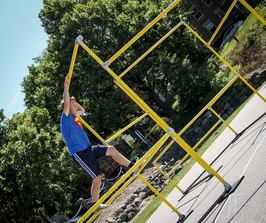
 A young participant at the 2015 Wisconsin Parkour Jubilee | "People often ask me, 'When did you start parkour?" My favorite response is, 'When did you stop?'" |
Today's post is about parkour and kids. Since our founding we have had a lot of communication with curious parents and youth leaders. There is something about parkour that gets people thinking that it fits, somehow, for kids; although in those early days (2007-2008 or thereabouts) people had a hard time putting their finger on it, especially since most of what was in the media back then was athletic 20-something guys throwing their bodies around in amazing stunts. So there was this tension between what looked like natural human play, and wanton recklessness, in peoples' minds.
A lot of our communication with parents took the form of, "My kid is already running, jumping, and climbing over everything, and it scares me; can you teach her how to do it safely?" We felt fortunate that there were parents willing to investigate this, rather than simply shutting down their children's natural movement instinct. We struggled back then with whether or not to offer kids classes. On the one hand, there seemed to be a demand for it; but on the other hand, it didn't feel right to be applying a structure to what kids did naturally.
Our position back then was that structured classes in parkour were inappropriate for children younger than about 10-12, and that is our position today. This is not to say that parkour classes are necessarily bad or harmful for younger children -- there are plenty of high-quality kids' parkour programs out there -- but rather, we wanted to move away from the American tendency to try to shuttle kids into structured programs too early. There is a lot of research out there showing that early sports specialization prior to adolescence can lead to higher incidence of injury as well as a loss of interest in athletic pursuits altogether (more on this in a later post).
Ryan Ford of Apex Movement in Colorado, and one of the most respected authorities on athletic training for parkour, opened his TED talk about parkour with, "People often ask me, 'When did you start parkour?" My favorite response is, 'When did you stop?'" This gets at the heart of the matter: kids do parkour on their own, naturally. Watch any child below the age of, say, 10 or so, out in the world. They are naturally curious, climbing on things, jumping off of things, hanging and swinging. If they are lucky, they have parents who encourage them in their endeavors. If they are very lucky, their parents continue to encourage these behaviors, and even model them themselves, in a lifelong way.
Culturally in the US, we have a fascination with achievement. There is certainly nothing wrong with this; however we must be mindful of the effects: more and more with each passing decade we are seeing a trend towards most structured activities, starting much younger, for children. Also we are seeing a greater emphasis on child safety: not necessarily a bad thing except to the extent that our safety measures actually take away from children’s necessary learning experiences. There seems to be a feeling among many adults, especially those with children or who care for children, that a structured class is the best way to allow children to engage in physical pursuits in the safest way possible. But this is rarely the case.
A lot of our communication with parents took the form of, "My kid is already running, jumping, and climbing over everything, and it scares me; can you teach her how to do it safely?" We felt fortunate that there were parents willing to investigate this, rather than simply shutting down their children's natural movement instinct. We struggled back then with whether or not to offer kids classes. On the one hand, there seemed to be a demand for it; but on the other hand, it didn't feel right to be applying a structure to what kids did naturally.
Our position back then was that structured classes in parkour were inappropriate for children younger than about 10-12, and that is our position today. This is not to say that parkour classes are necessarily bad or harmful for younger children -- there are plenty of high-quality kids' parkour programs out there -- but rather, we wanted to move away from the American tendency to try to shuttle kids into structured programs too early. There is a lot of research out there showing that early sports specialization prior to adolescence can lead to higher incidence of injury as well as a loss of interest in athletic pursuits altogether (more on this in a later post).
Ryan Ford of Apex Movement in Colorado, and one of the most respected authorities on athletic training for parkour, opened his TED talk about parkour with, "People often ask me, 'When did you start parkour?" My favorite response is, 'When did you stop?'" This gets at the heart of the matter: kids do parkour on their own, naturally. Watch any child below the age of, say, 10 or so, out in the world. They are naturally curious, climbing on things, jumping off of things, hanging and swinging. If they are lucky, they have parents who encourage them in their endeavors. If they are very lucky, their parents continue to encourage these behaviors, and even model them themselves, in a lifelong way.
Culturally in the US, we have a fascination with achievement. There is certainly nothing wrong with this; however we must be mindful of the effects: more and more with each passing decade we are seeing a trend towards most structured activities, starting much younger, for children. Also we are seeing a greater emphasis on child safety: not necessarily a bad thing except to the extent that our safety measures actually take away from children’s necessary learning experiences. There seems to be a feeling among many adults, especially those with children or who care for children, that a structured class is the best way to allow children to engage in physical pursuits in the safest way possible. But this is rarely the case.
 RSS Feed